
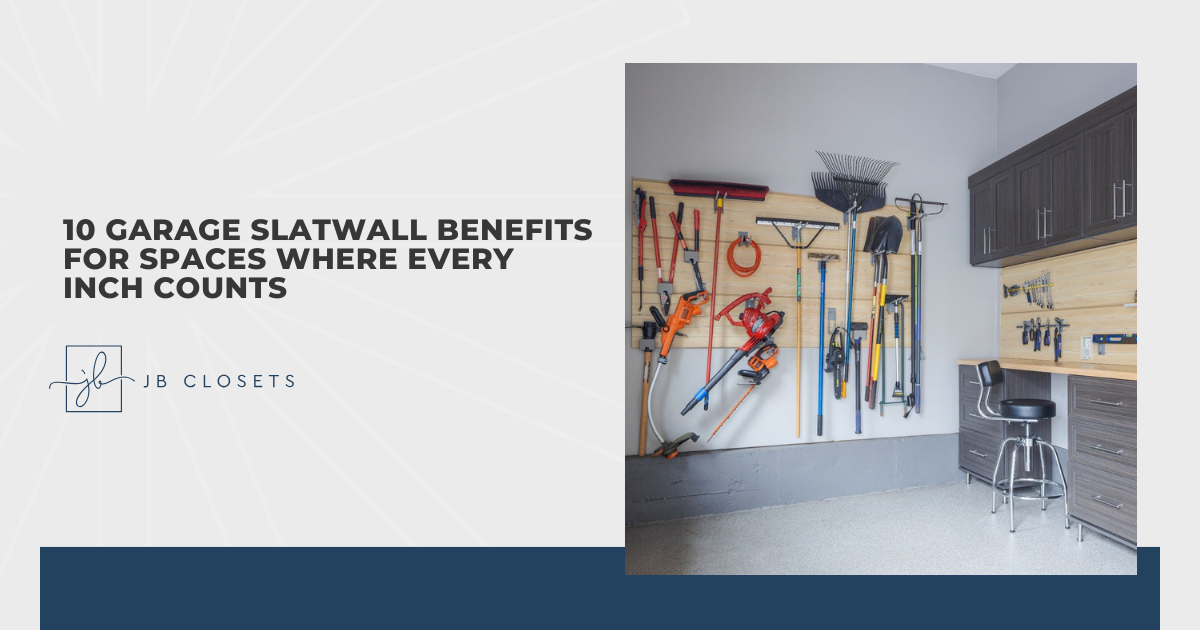

10 Garage Slatwall Benefits for Spaces Where Every Inch Counts

Bret Chevrier • September 22, 2026
10 Garage Slatwall Benefits for Spaces Where Every Inch Counts

Most garages end up losing storage space long before they run out of square footage. Garage slatwall doesn't ask you to add a single square foot to your garage. It simply puts your existing walls to work. Bikes, bins, and tools that used to pile up on your floor finally get a spot of their own once the wall starts holding its share.


Grooved panels give the wall a real track system, built to carry that load safely. Hooks, bins, and shelves all lock into that same track, so you can rearrange the layout anytime your storage needs change. Whatever used to pile up on the floor moves onto the wall and actually stays there, without sliding back into a heap after a few weeks. Weeks later, everything is still exactly where you put it. 


I've seen how much garage slatwall changes a cluttered space, and these are the benefits that make the biggest difference:


  • Maximizes vertical wall storage
  • Keeps frequently used tools within reach
  • Adapts to changing storage needs
  • Frees up floor space for parking and projects
  • Withstands everyday garage conditions
  • Expands with a wide range of compatible accessories
  • Organizes gear by category or zone
  • Installs without major construction
  • Gives the whole garage a clean, finished look
  • Fits garages of any size


Ten ways one wall can change how your garage works. See what each one brings to your garage next.


Floor-to-ceiling wall space in a typical garage rarely gets used past the first four feet. Garage slatwall changes that by giving you a mounting surface that runs as high as your ceiling allows. Every extra foot of panel becomes a foot of storage you didn't have before, whether it holds bins, bikes, or seasonal gear. Your garage stops losing square footage to wasted vertical space the moment the panels go up.


Traditional shelving units take up floor space to hold items that could hang on a wall. Panels turn blank vertical space into functional storage without requiring a single freestanding unit. You get to reclaim that floor space for a workbench, extra parking, or simply room to move around. The wall becomes the workhorse, not the floor.


Height is the real advantage here, since most homeowners never use the top half of their garage walls. Stacking bins, shelves, and hooks vertically means you store more without widening your footprint an inch. Even a narrow single-car garage gains meaningful storage once its full wall height comes into play. Turning unused vertical space into storage makes it some of the most useful square footage in the whole garage.

How many times have you dug through a bin looking for the one wrench you actually needed? Hooks and bins mounted on a panel put your most-used tools in plain sight, so you stop digging through everything else to find them. Frequency and project type make good grouping rules, so what you reach for weekly stays at eye level while rarely used tools move higher up. Nothing stays buried in a bin waiting to be found.


Time matters as much as organization when you're mid-project. I can grab a tape measure or a specific wrench without pausing to think about where it lives, since everything hangs exactly where I left it. Immediate access matters most in the middle of a project, when stopping to search breaks your momentum. A wall organized by task turns a ten-minute search into a two-second grab.


Anyone in the household can find what they need without asking where you keep something specific. Labels or shadow outlines behind each hook make it obvious where a tool belongs, so putting things back stays as easy as taking them down. A borrowed rake or an extra hand tool goes back to the same spot every time, without drifting into a random drawer. This kind of consistency is what keeps a tool wall useful long after installation day

Kids grow out of bikes, hobbies come and go, and the gear that filled your garage last year isn't always the gear filling it this year. A fixed shelf or a built-in cabinet can't adjust to any of that, but a slatwall panel doesn't ask you to guess right the first time. Moving a hook or swapping a bin for a shelf takes minutes, not a weekend project. Your storage keeps pace with your life instead of falling behind it.


Seasonal shifts are where this flexibility shows up most. Snow gear takes over the wall in winter, and it gets swapped for gardening tools and pool equipment once the weather turns. I've rearranged entire sections of a garage wall in an afternoon just by relocating a few hooks and adding a shelf where a bin used to sit. No new holes, no patching, no starting over from scratch.


A new hobby or a growing family can shift what a garage needs to hold within a single season. Slatwall accommodates that shift because the track itself never changes, only what attaches to it. Whatever you're storing next year attaches the same way whatever you're storing today does. Few storage systems adjust this easily without tools, patching, or a second trip to the hardware store.

A car parked on the driveway because the garage doesn't have room for it anymore is a familiar sight in a lot of neighborhoods. Boxes, bins, and stray equipment end up spread across the floor when the walls aren't doing any of the work. Once storage moves up onto a slatwall panel, the floor opens back up for what it was actually meant to hold. Your garage starts functioning as a garage again instead of overflow storage with a car squeezed in somewhere.


Workbenches and hobby stations need floor space to function, and that space disappears fast when bins and boxes take priority. Clearing the floor gives you room to set up a table saw, a workbench, or whatever project needs spreading out. A two-car garage can go from fitting one car and a maze of clutter to fitting both cars and a full workbench, just by moving everything onto the wall. Floor space becomes usable again once it stops doubling as a storage shelf.


Parking two cars comfortably requires more clearance than most garages have once storage creeps in from every direction. Slatwall clears that clutter without asking you to get rid of anything you actually want to keep. Opening both doors without hitting a bin or ducking under a hanging rake becomes possible again. What used to be a tight squeeze turns into a garage that works the way it was designed to.

Your garage takes a beating that living spaces never have to deal with. Temperatures swing from freezing mornings to scorching afternoons, humidity creeps in during summer storms, and dust settles on everything within days of a good cleaning. I've seen cheap shelving warp and hardware rust after a single humid season, long before it should have worn out. A slatwall panel has to hold up under all of that to be worth mounting on your wall.


Material quality determines whether your panel actually survives these swings or starts failing within a year. PVC and heavy-duty MDF panels resist the warping that plywood or particleboard develops once humidity gets involved. Metal hardware finished for corrosion resistance keeps your hooks and brackets from seizing up or rusting through. None of this shows up on day one, but it's what separates a wall system that lasts from one you'll be replacing.


Dust and grime are a constant in most garages, whether from vehicles, yard equipment, or a workbench that never quite gets swept. Your panel surface wipes clean without staining or absorbing whatever gets tracked onto it. Hardware that's properly sealed keeps functioning smoothly even after years of temperature swings and occasional moisture exposure in your garage. Choosing a system built for these conditions from the start saves you from replacing it a few years down the road.

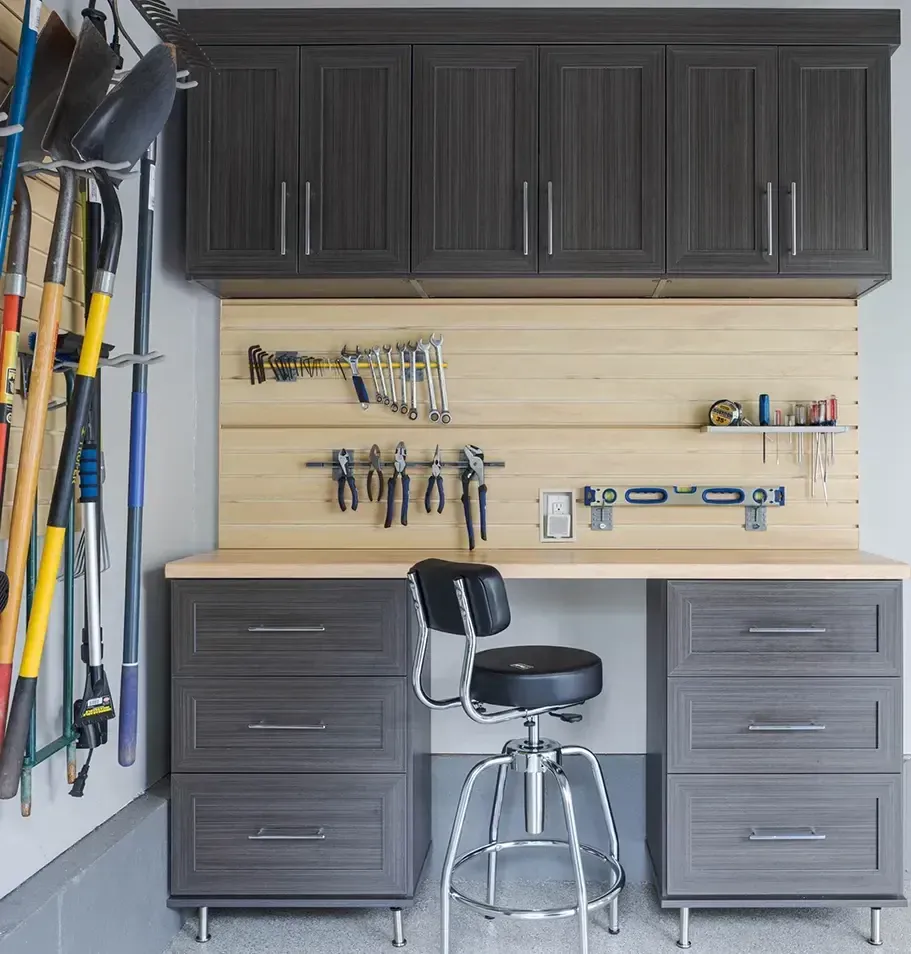
Garage workshop with dark cabinets, pegboard tools, workbench, and a stool.

Every household stores something a standard hook or shelf was never built to handle. Slatwall accessories exist because no single accessory type covers everything from work gloves to ladders to seasonal wreaths. Swapping one accessory for another takes seconds, since everything locks into the same track regardless of size or shape. Your garage ends up outfitted with accessories that match what it actually holds, without settling for a generic size.


The accessory range covers far more than the basics:


  • Utility Hooks: Hold rakes, hoses, and extension cords without letting them tangle on the floor.
  • Wire Baskets: Corral loose items like gloves, sports gear, or cleaning supplies in one visible spot.
  • Bin Brackets: Hold clear or labeled bins for anything you'd rather keep out of sight but still reachable.
  • Shelf Brackets: Add flat surfaces for paint cans, small appliances, or overflow pantry items.
  • Bike Hooks: Keep bikes off the floor and out of the way without needing a separate rack.
  • Tool Holders: Grip specific tools like shovels or brooms so they don't slide or shift.

Buying separate storage solutions for every category of item gets expensive fast. One track supports everything from heavy-duty hooks to lightweight bins, so upgrading later doesn't mean replacing the whole wall. Combining several accessory types on one panel creates a layout tailored to whatever your garage holds this year. A garage that stores gardening tools, sports gear, and holiday decor finally has accessories to match all three. 

A garage that mixes gardening tools, sports equipment, and holiday decor in one pile makes finding anything a guessing game. Slatwall panels let you split the wall into zones, so gear stays grouped with the things that belong next to it. What you're looking for stays in its designated section instead of buried under whatever got hung up last. Your garage starts working more like a system and less like a catch-all.


Zoning works best when it's built around how you actually use the space, not just what fits where:


  • Sports and Recreation Zone: Groups bikes, helmets, and balls near the exit closest to the driveway or yard.
  • Seasonal Storage Zone: Keeps holiday decorations and off-season gear together in one section, out of daily rotation.
  • Yard and Garden Zone: Places rakes, hoses, and hand tools near the door leading outside.
  • Automotive Zone: Holds jumper cables, funnels, and car care supplies close to where the car is parked.
  • Cleaning Supplies Zone: Sections off mops, brooms, and cleaning products away from anything food or garden related.

Setting up zones takes some upfront thought, but it pays off every time you walk into the garage looking for something specific. My own garage runs this same way, sports gear on one wall and yard tools on another, and it's cut down on the searching considerably. Kids and other household members figure out the system faster too, since gear lives in predictable places instead of wherever there is room. A garage organized by zone stays that way longer than one organized by whatever happened to be available at the time.

Major construction is the last thing anyone wants tacked onto a garage upgrade. Slatwall panels mount directly to wall studs, so there's no drywall to cut, patch, or repaint once the job is done. A typical wall section goes up within a few hours once the studs are marked and the first panel is level. Your garage gets a finished storage wall without the mess of a full renovation.


Studs get located first, marked with a stud finder that maps their exact spacing across the wall. Panels attach with lag screws driven into those marked studs, holding the weight of whatever you hang on the track later. A level line across the first panel keeps every following piece square, so the whole wall lines up cleanly from one end to the other. Trim pieces along the edges finish the installation without leaving gaps or exposed screws you'd otherwise see.


Permits and inspections that come with bigger garage renovations don't apply here, since slatwall installation doesn't touch plumbing, electrical, or structural walls. Your garage stays usable throughout the process, since there's no need to clear it out for days at a time. A single wall panel or an entire garage's worth of paneling can go up in one weekend without hiring a full renovation crew. What would take weeks as a full remodel takes a fraction of that time as a slatwall installation.

Mismatched shelving, pegboard with mismatched hardware, and bins stacked in whatever container was on sale rarely add up to a garage that looks put together. Slatwall panels replace that patchwork with a single, uniform surface that runs across the wall. Every hook, bin, and shelf attaches to the same track, so the whole setup reads as one system instead of several unrelated pieces. Your garage starts looking like a finished space rather than a work in progress.


Panel colors and finishes come in options that can match your garage's existing walls, cabinets, or trim. A wood-tone panel pairs naturally with cabinetry, while a painted white or gray finish brightens a garage that doesn't get much natural light. Consistent spacing between hooks and shelves adds to that polished look, since nothing hangs at a random height or angle. Small details like these are what separate a garage that looks organized from one that just has fewer things on the floor.


A clean-looking garage does more than satisfy your own eye when you pull in each day. Buyers touring a home tend to notice a finished garage the same way they notice an updated kitchen, since it signals the rest of the house has been cared for. Guests, neighbors, and anyone who steps inside see a space that looks intentional rather than thrown together. The garage you used to keep the door closed on turns into one you're fine leaving open.

A single-car garage and a three-car garage face the same storage problem on different scales. Slatwall panels work in both, since the system scales to whatever wall space you actually have rather than requiring a minimum footprint to be worth installing. A narrow one-car garage might only fit one wall's worth of panels, while a larger garage can wrap storage around two or three walls. The panels adjust to whatever footprint you're working with, so the storage matches your garage's actual size.


Shared garages add another layer to this, since two or three people often need to divide the same wall space. Panels split cleanly into sections, so each person gets a designated area without needing to build separate storage structures. A family with kids' bikes, a partner's tools, and shared yard equipment can all coexist on one wall, each in its own zone. I've helped set up shared garages this way and watched the constant negotiating over space disappear almost immediately.


Smaller garages benefit the most from a system that doesn't demand extra floor space to function. Every panel adds storage vertically, so even a single-car garage with barely any spare footage gains real capacity. Larger garages get the same benefit at scale, filling more wall space with more panels rather than needing an entirely different storage approach. Whether your garage holds one car or three, the wall works the same way and scales with the space you've got.


Walk into your garage tonight and notice what's actually on the walls versus what's piled on the floor. With garage slatwall in place, every tool, bin, and stray piece of equipment finally has a spot of its own, off the ground and within reach. You stop losing time to searching and start losing the guilt that comes with a garage door you don't want to open. The space was always there, waiting on walls that finally had something to offer..

Share this article

Recent Posts

How to Design Your Walk-In Closet for a Faster Morning Routine
By Bret Chevrier August 25, 2026
Rethink your walk-in closet with a few practical tweaks that help you see what you own, stay organized, and start each day without the usual morning scramble.

Creative Custom Home Office Design Ideas for Small Spaces
By Bret Chevrier July 20, 2026
Explore creative custom home office design ideas for small spaces, including built-in desks, closet conversions, and clever space-expanding lighting solutions.
How Much Does It Cost to Install Custom Garage Cabinets?
By Bret Chevrier June 29, 2026
Learn what custom garage cabinets cost to install and the factors that shape your final price so you can set a realistic budget before you call an installer.

Practical Design Tips for Couples Sharing a Custom Closet System
By Bret Chevrier June 26, 2026
Design a custom closet system that two people can share comfortably with smart zoning, adjustable storage, and a layout planned around how you both get ready.

Smart Storage Strategies to Maximize Your Custom Closet Systems
May 28, 2026
Learn how to get more out of your custom closet system with simple storage strategies that keep your space organized, functional, and working for you every day.

8 Storage & Organization Problems Custom Closet Systems Can Solve
By Bret Chevrier May 28, 2026
Discover how custom closet systems can solve the most common storage and organization problems homeowners face, from limited space to cluttered entryways.
Custom Closet Design Tips for Small Bedrooms
By Bret Chevrier September 28, 2023
Maximize your small bedroom with custom closet design tips that enhance storage, improve organization, and create a stylish, clutter-free space.

Small Entryway Closet Makeover: Space Saving Tips
By Bret Chevrier September 14, 2023
Transform your small entryway closet with smart space-saving tips, clever organization ideas, and stylish solutions to keep your home tidy and functional.
Custom Closet vs. Standard Closet: What Are the Differences?
By Bret Chevrier August 31, 2023
Discover the key differences between custom closets and standard closets, from design flexibility and storage efficiency to cost, quality, and overall home value.
How to Create Your Dream Laundry Room
By Bret Chevrier August 17, 2023
Design your dream laundry room with smart storage, efficient layouts, and stylish features that make everyday chores easier and more enjoyable.
Show More